Can You Straighten Wet Hair?
Not with an ordinary flat iron - wet hair gives way at a far lower temperature than dry hair. These five tools are designed for it, and they publish the numbers to prove it.
How this page is funded: the buy links below are affiliate links, and Heat Index earns a commission on qualifying purchases at no cost to you. Nothing on this page was supplied by a manufacturer, and commission plays no part in the ranking — read the full disclosure. Picks are chosen from published specifications, not from hands-on testing; the method is written down so you can check it. Prices last verified October 23, 2026.
No - not with a normal flat iron, and no setting makes it acceptable. The tool to buy if you want to go from wet to straight in one pass is the Dyson Airstrait, because it has no plates at all and publishes every temperature it uses: 175F, 230F and 285F in wet-to-dry mode. If that is out of budget, the Remington Wet2Straight is the only vented-plate iron here, and it is built for damp hair rather than soaking hair. Those are the two sentences; the rest of this page is why.
The reason this question has a hard answer rather than a cautious one is a number. Published work on keratin reports that wet keratin denatures between 120C and 150C — 248F to 302F — far lower than dry keratin. A flat iron set to 350F is operating above that entire range. On dry hair 350F is a styling temperature; on wet hair it is past the point where the fiber gives way, which is why this is the one unqualified rule on this site.
How we judged this list
Criteria first, because on this question the criteria are unusual: the tool has to be judged on the mechanism that handles water, not on how straight it gets hair.
- What happens to the water. This is the whole category. A sealed plate pressed onto damp hair turns the moisture inside the fiber to steam with nowhere to go. A vented plate gives it an exit; an air-based tool never traps it at all. A tool with no answer to this question is not a wet-to-dry tool regardless of what the box says.
- Whether the temperature is published, and how high it goes. Against the 248-302F wet-keratin range, a published ceiling is worth more here than anywhere else on the site. Two of these five publish every setting in degrees. One publishes none.
- How wet it actually means. "Wet-to-dry" covers three genuinely different starting conditions - soaking, towel-dried, and roughly 80 percent dry - and the gap between them is where most disappointment in this category comes from. Every pick below is labeled.
- Whether the heat is regulated or just set. A target temperature is a promise; a measured one is a specification. Dyson publishes 30 readings a second, Shark publishes 1,000.
- What it gives up. None of these produces the glass-flat finish a 450F titanium iron produces. That is the honest trade for not ironing wet hair, and it is worth stating before the ranking rather than after it.
Quick picks
Ranked, with the reasoning underneath. Tap any row to jump to that write-up; tap the price to check it on Amazon. Prices come from the live layer, never from this page.
| # | Product | Best for | Type | Price |
|---|---|---|---|---|
| 1 | 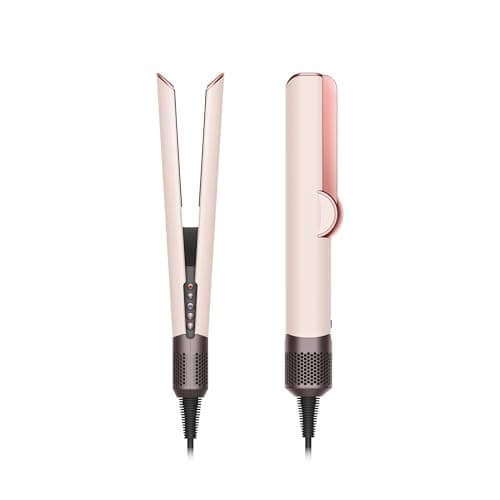 Dyson Airstrait StraightenerIt straightens with two converging jets of air instead of hot plates, which means it works from wet and its highest published temperature is still well under what a conventional iron runs at. | Drying and straightening in one pass, with no plate contact | Wet-to-dry air straightener | |
| 2 | 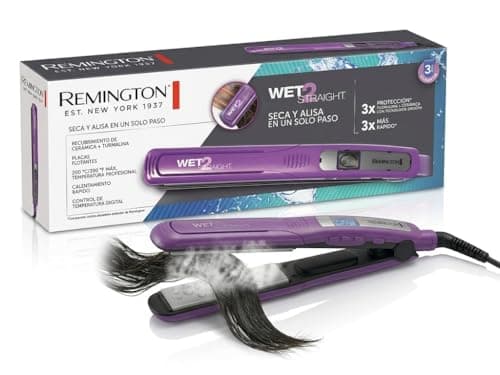 Remington Wet2Straight 1-inch Flat Iron with Digital ControlsSteam vents in the plates let moisture escape instead of trapping it against the hair, which is the one mechanism that makes ironing damp hair a design rather than a mistake. | Straightening hair that is still damp, on purpose | Vented wet-to-dry iron | |
| 3 | 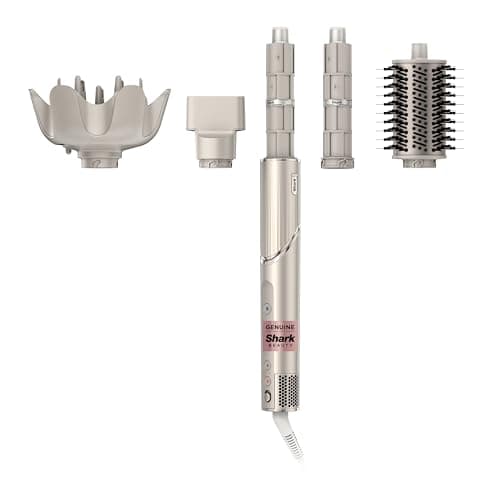 Shark FlexStyle Air Styling & Drying System (HD435)The one multi-styler whose published temperature ceiling is low enough to justify the price on hair that is already fragile, and it converts to a straight dryer in a twist. | One tool that dries and styles, on curly or coily hair | Multi-styler + dryer | |
| 4 | 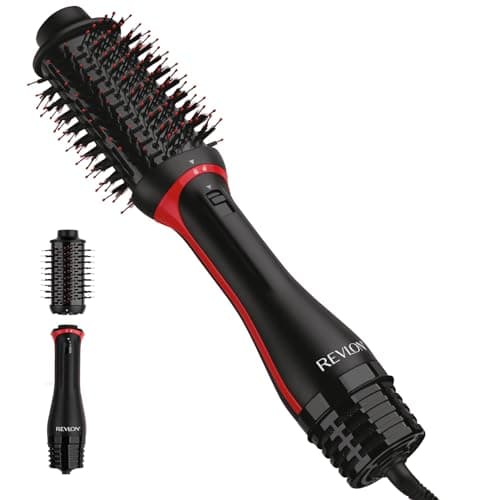 Revlon One-Step Volumizer PLUS 2.0A 2.4-inch oval barrel at 1,100W and 15 ounces: the tool that made at-home blowouts a normal thing, in its most refined version. | A first blow-dry brush that does not need technique | One-step dryer brush | |
| 5 | 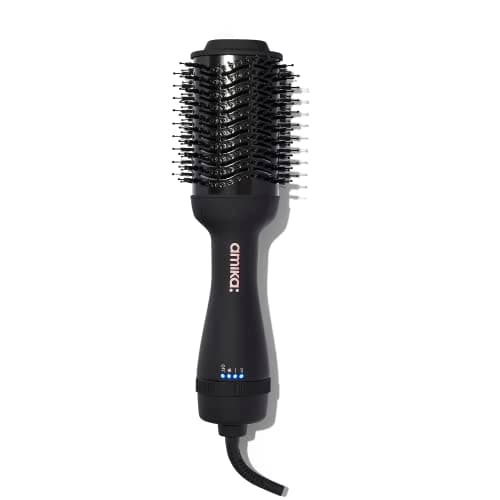 amika Hair Blow Dryer Brush 2.0The only blow-dry brush here that publishes its three temperatures — 115F, 190F and 230F — and every one of them is below the damage thresholds in the research. | Knowing exactly how hot the brush is | One-step dryer brush | Check price#ad |
#1 · Drying and straightening in one pass, with no plate contact
Dyson Airstrait Straightener
It straightens with two converging jets of air instead of hot plates, which means it works from wet and its highest published temperature is still well under what a conventional iron runs at.
| Motor | 13-blade impeller spinning up to 106,000 rpm, propelling 11.9 liters of air per secondsource |
|---|---|
| Air pressure | Up to 3.6 kPa, enough to straighten hair as it driessource |
| Power | 1,600W at 120Vsource |
| Wet-to-dry temperatures | Three preset airflow temperatures: 175F, 230F and 285Fsource |
| Dry styling temperatures | 250F or 285F, plus an optional Boost modesource |
| Heat regulation | Glass bead thermistors in the machine arms regulate airflow temperature up to 30 times a secondsource |
| Weight | 2.2 lbsource |
What those numbers mean
There are no plates, so nothing hot is ever pressed onto the hair. The two arms close to aim converging airflow down the section, and the straightening is done by that airflow and the tension of your own hand.
285F is the highest number it publishes, and that is the figure to weigh against a conventional flat iron. It is below the temperature at which published research reports cuticle degradation beginning, and roughly 165F below where a titanium iron tops out.
Working from wet is the structural difference from every other straightener here. Drying and straightening collapse into one pass, which is where the time comes back — not from being faster per section.
1,600W and 2.2 lb are both published, which is more than Dyson discloses about the Airwrap. On a tool at this price, a stated wattage and a stated weight are worth something.
What it does well
- Works from wet, collapsing drying and straightening into one pass
- No hot plates ever touch the hair
- Every temperature is published, and the highest is 285F
- Thermistors regulate airflow temperature up to 30 times a second
- Published wattage and published weight, which Dyson does not state for the Airwrap
What it does not
- It only straightens — it will not curl, and it is not a conventional dryer
- At 2.2 lb it is heavier than most corded irons
- Air-straightened hair is smoothed rather than pressed, so it will not hold a poker-straight finish as long as plates do
- Among the most expensive tools in this registry
Skip this one if: Skip it if you want one tool that does more than one thing, or if you need a glass-flat finish that survives humidity. It does a single job without plate contact; a plated iron presses the cuticle flat and holds that shape longer, and a multi-styler will also curl.
#ad · how this is funded · price as of October 23, 2026
#2 · Straightening hair that is still damp, on purpose
Remington Wet2Straight 1-inch Flat Iron with Digital Controls
Steam vents in the plates let moisture escape instead of trapping it against the hair, which is the one mechanism that makes ironing damp hair a design rather than a mistake.
| Wet-to-dry mechanism | Steam vents stated to remove moisture from damp hair during styling, cutting styling time by up to 3xsource |
|---|---|
| Temperature | Digital LCD controls, up to 390Fsource |
| Plates | 1-inch floating ceramic and tourmaline platessource |
| Heat-up | 15 to 30 secondssource |
What those numbers mean
The vents are the entire product. A sealed plate pressed onto damp hair turns the water inside the fiber to steam with nowhere to go; a vented plate gives it an exit. That is why this iron can be used on damp hair and a conventional one cannot, and it is a mechanical difference rather than a marketing one.
A 390F ceiling is below the 450F that titanium irons advertise and above the 302F at which cuticle degradation is reported to begin. For damp hair that is still a lot of heat, which is why the digital dial matters more here than on a dry-only iron.
Remington does not publish how many degrees the dial steps in, a wattage, a weight, a voltage rating or an auto shut-off interval on this listing. That is four absences on a tool with an LCD screen, and it is the main reason this is not the top pick on its own page.
What it does well
- Steam vents are a real mechanism for damp hair, not a claim
- Digital LCD dial rather than a numbered knob
- 15 to 30 second heat-up, published
- Floating ceramic and tourmaline plates
What it does not
- No published voltage rating, so treat it as single voltage
- No published auto shut-off interval
- No weight or wattage published
- 390F is still well above the reported cuticle-damage threshold
Skip this one if: Skip it if your hair is fine, bleached or breaking. Damp hair is the weakest state hair is ever in, and no venting system makes 390F a sensible thing to do to fragile hair - dry it first and use a lower-ceiling iron.
#ad · how this is funded · price as of October 23, 2026
#3 · One tool that dries and styles, on curly or coily hair
Shark FlexStyle Air Styling & Drying System (HD435)
The one multi-styler whose published temperature ceiling is low enough to justify the price on hair that is already fragile, and it converts to a straight dryer in a twist.
| Power | 1,300Wsource |
|---|---|
| Settings | 4 heat and 3 airflow settings, plus a cool shotsource |
| Heat regulation | Measures and regulates temperature 1,000 times per secondsource |
| Weight | Just over 1.5 lbsource |
| In the box (HD435) | Curl-defining diffuser, oval brush, Coanda curlers, styling concentratorsource |
What those numbers mean
One thousand temperature readings per second is not marketing garnish. A dryer that samples that often can hold a target instead of overshooting it, which is the difference between a stated setting and an actual one.
The convertible design is the practical argument. The same barrel that dries your hair rotates to become a styler, so a single purchase covers the drying step and the shaping step rather than two tools that both need storage.
1,300W is below the 1,875W most American dryers advertise. On thick hair that means a longer dry; on curly or coily hair it means the airflow is not shaking the pattern apart while it works.
What it does well
- Published heat regulation at 1,000 readings per second, the tightest figure any brand publishes at this price
- Converts between dryer and styler without swapping tools
- Diffuser and curl attachments come in the box on the HD435 rather than as extras
- Light enough at just over 1.5 lb to hold through a full blowout
What it does not
- 1,300W is genuinely less power than an 1,875W AC dryer, and thick hair will feel it
- The attachment set is bulky to store
- Costs several times what a competent 1,875W dryer costs
Skip this one if: Skip it if what you actually need is a fast dryer for thick hair and nothing else. A 1,875W AC dryer will dry the same head sooner and cost a fraction as much; the FlexStyle price buys styling versatility, not drying speed.
#4 · A first blow-dry brush that does not need technique
Revlon One-Step Volumizer PLUS 2.0
A 2.4-inch oval barrel at 1,100W and 15 ounces: the tool that made at-home blowouts a normal thing, in its most refined version.
| Power | 1,100W motorsource |
|---|---|
| Barrel | 2.4-inch oval barrelsource |
| Settings | Four settings — low, medium, high and coolsource |
| Barrel materials | Ceramic, titanium and tourmaline, with ionic technologysource |
| Weight | 15 ozsource |
What those numbers mean
An oval barrel is doing something a round brush cannot: the flat faces smooth while the curved ends bend the end of the section. That is why one pass produces both smoothness and a bit of shape.
1,100W is modest next to a standalone dryer, and it should be. This tool is in contact with your hair rather than held six inches away, so the same wattage delivers far more heat to the strand.
Fifteen ounces is the specification that decides whether you finish. A brush you hold at head height for twenty minutes is an endurance event if it is heavy.
What it does well
- Combines the dryer and the round brush, which removes the two-handed coordination problem
- Oval barrel smooths and shapes in one pass
- A genuine cool setting for setting the style
- 15 oz, light enough for a long session
What it does not
- Revlon does not publish an actual temperature for any setting
- A one-step brush cannot match a separate dryer and round brush for control
- 2.4 inches is too large for short hair or a fringe
Skip this one if: Skip it if your hair is soaking wet and very thick. These brushes are designed for hair towel-dried to roughly 80 percent, and starting from wet is where people conclude they are underpowered.
#5 · Knowing exactly how hot the brush is
amika Hair Blow Dryer Brush 2.0
The only blow-dry brush here that publishes its three temperatures — 115F, 190F and 230F — and every one of them is below the damage thresholds in the research.
| Heat and speed settings | 3 adjustable settings at 115F, 190F and 230Fsource |
|---|---|
| Power | 950Wsource |
| Barrel | Tourmaline-coated oval barrel generating negative ions and infrared heatsource |
| Bristles | Mixed long and short bristles to detangle, smooth and minimize breakagesource |
| Weight | 0.85 lb / 380 gsource |
| Cord | 9 ft with 360-degree swivelsource |
| Warranty | 2-year warrantysource |
What those numbers mean
Three published temperatures on a blow-dry brush is close to unique, and the numbers are the reassuring part. Even the top setting of 230F sits below the 302F line and far below anything the thermal research associates with cortex damage.
950W is the lowest wattage of any brush here and, for hair that is bleached or fine, that is a feature. Less power means a slower dry and a lower ceiling, and slower is the safe direction.
0.85 lb is the lightest tool in this entire registry. On a twenty-minute blowout, that is the specification you will notice most.
What it does well
- Publishes all three temperatures, and all three are conservative
- 0.85 lb, the lightest tool here
- 9-foot swivel cord and a 2-year warranty
- Mixed bristle lengths for detangling without dragging
What it does not
- 950W is genuinely slow on thick hair
- A 230F ceiling will not produce a sharp, glassy finish
- Priced above the Revlon brushes it competes with
Skip this one if: Skip it if your hair is thick and you want to be done quickly. 950W and a 230F ceiling are a deliberate choice for hair health, and on dense hair that choice reads as a long, slow blowout.
What each one means by wet
This is the table that decides which of these is right for you, and it is the one nobody prints. The left column is the condition the maker designed the tool to start from; starting wetter than that is where these tools get called underpowered.
| Tool | Starts from | How it handles the water | Published temperature |
|---|---|---|---|
| Dyson Airstrait | Genuinely wet | No plates at all - two converging air jets straighten as they dry | 175F, 230F, 285F wet-to-dry; 250F or 285F dry |
| Remington Wet2Straight | Damp, not soaking | Steam vents in the plates let moisture escape instead of trapping it | Up to 390F, digital LCD |
| Shark FlexStyle | Wet, as a dryer first | Dries with airflow, then the same barrel converts to a styler | 4 heat settings, regulated 1,000 times a second; no degrees published |
| Revlon One-Step PLUS 2.0 | Towel-dried to roughly 80 percent | Hot airflow through a brush barrel - contact, but moving air not pressure | Low, medium, high and cool; no degrees published |
| amika Blow Dryer Brush 2.0 | Towel-dried to roughly 80 percent | Same brush mechanism, at a much lower ceiling | 115F, 190F and 230F - all three published |
Two things fall out of that table. The first is that only one tool here starts from genuinely wet hair, and it costs accordingly. The second is that the lowest published ceiling belongs to a brush rather than to an iron — the amika's top setting of 230F sits below the bottom of the wet-keratin range, which makes it the only tool here that physically cannot reach the temperature this page is warning about.
wet keratin denatures 120-150C | dry keratin denatures far higher
248-302F versus a 350F plate setting
The thresholds are not on a single sliding scale. Dry hair at 350F is being styled; wet hair at 350F is being structurally altered, because the water inside the fiber lowers the temperature at which the protein gives way. That is why this page exists as a category question rather than a technique tip, and why the temperature chart starts by telling you to dry first.
The vented-plate argument, at length
A wet-to-dry flat iron is not a normal iron with a sticker on it. Remington's mechanism is a set of vents cut through the plates, and the claim is specific: the vents remove moisture from damp hair as you straighten, which Remington states cuts total styling time by up to three times compared with blow-drying and then ironing.
That is a real mechanical difference and it is worth understanding rather than trusting. When a sealed plate closes on a damp section, the water in the fiber flashes to steam and has nowhere to go except through the cuticle on its way out — which is the actual damage mechanism people describe as "sizzling". A vent gives the steam a path that does not go through the hair's surface. It does not make the hair cooler, and it does not make 390F a low temperature.
The no-plate approach, and what it costs
The Airstrait removes the premise of the question. There are no plates, so nothing hot is ever pressed onto the hair; two arms close to aim converging jets of air down the section, and the straightening is done by airflow at up to 3.6 kPa and the tension of your own hand. Dyson publishes 1,600W, a 13-blade impeller at up to 106,000 rpm, 11.9 liters of air per second, and glass bead thermistors regulating the airflow temperature up to 30 times a second.
The number that matters on this page is the ceiling: 285F is the hottest figure it publishes, which sits below the roughly 302F at which cuticle degradation is reported to begin and around 165F below where a titanium iron tops out. That is the trade in one figure — you give up the top of the temperature range and in exchange the drying step and the straightening step become the same pass. The full Airstrait review reads the rest of the spec sheet, and Airwrap vs Airstrait settles which Dyson is the right one if you are choosing between them.
What you do not get is a glass-flat finish that holds through humidity. If that is the result you are buying, no tool on this page delivers it and you want a plated iron used on dry hair instead — the straighteners hub ranks those.
Brushes are the mass-market answer, with an asterisk
Most people who ask this question do not want a new category of tool; they want to stop blow-drying and then ironing. A hot-air brush is the answer that already sits in most bathrooms, and it works on damp hair because the heat arrives in moving air rather than through a pressed plate.
- The asterisk is 80 percent. Revlon's own guidance for the One-Step line is hair towel-dried to roughly 80 percent, and starting from soaking wet is exactly where people conclude these brushes are underpowered. They are not underpowered; they are being used a step too early.
- The Revlon PLUS 2.0 is the broadly useful one — 1,100W, a 2.4-inch oval barrel whose flat faces smooth while the curved ends bend the section, four settings including a genuine cool shot, and 15 oz so you can finish. It publishes no temperature for any setting, which is the category norm and still a gap.
- The amika publishes all three of its temperatures — 115F, 190F and 230F — and that is close to unique in this category. At 950W it is the slowest tool here and on damp fine or bleached hair that is the point: a 230F ceiling cannot reach the wet-keratin range at all.
- Neither will straighten curly hair flat. A brush lays the cuticle down and adds movement; it does not compress the fiber. Blow-dry brushes covers the format against its alternatives and how to get a blowout at home covers the technique.
Which one, by what you are starting with
- Hair genuinely wet out of the shower, and you want it straight — the Dyson Airstrait. It is the only tool here designed for that starting condition, and its 285F ceiling is lower than most irons' lowest setting.
- Damp hair and a real budget — the Remington Wet2Straight. Vented plates are a mechanism rather than a marketing line, and the digital dial means you can repeat a temperature rather than a knob position.
- One tool for drying and styling, on curly or coily hair — the Shark FlexStyle. It dries from wet as a dryer, then the same barrel becomes a styler, and 1,000 temperature readings a second is the tightest regulation figure anyone publishes near this price. The FlexStyle review has the detail.
- Damp hair, and you want the familiar answer — the Revlon One-Step PLUS 2.0. The tool that made at-home blowouts normal, in its most refined version. The One-Step review covers the original against it.
- Bleached, fine or breaking hair — the amika, and the reason is the ceiling rather than the brand. 230F maximum means the tool physically cannot do the thing this page warns about. Flat irons for damaged hair is the wider shortlist for hair in that condition.
The free half of the answer
Whichever tool you buy, two habits do more for the outcome than the purchase does. The first is rough-drying to 80 percent before any tool with contact touches your hair, which takes three minutes with a dryer on medium heat and high speed and removes the entire wet-keratin problem. The second is a heat protectant applied to damp hair before drying, not to dry hair before ironing — the drying stage is heat exposure too, and it is the stage most people leave unprotected.
What a heat protectant actually does sets out what the film can and cannot do, and how to prevent heat damage covers the rest. Neither of those pages is selling you anything, and between them they are worth more than the difference between any two tools on this list.
Related
The straighteners hub has the full ranking for dry hair, straightening brushes covers the heated-brush format that is explicitly NOT a wet tool, and the flat iron temperature chart gives the setting your hair should be on once it is dry.
Questions people actually ask
Can you use a flat iron on wet hair?
No. Wet keratin is reported to denature between 120C and 150C - 248F to 302F - far below dry keratin, so a 350F plate on wet hair is operating past the point of irreversible structural damage. No setting makes it acceptable. A tool specifically built for damp hair, either with vented plates or with no plates at all, is a different mechanism and the only safe way to start from damp.
What is the best wet-to-dry straightener?
The Dyson Airstrait, on published specifications. It has no heated plates at all - it straightens with two converging jets of air - and it publishes three wet-to-dry temperatures of 175F, 230F and 285F, all of which sit below the roughly 302F at which cuticle degradation is reported to begin. For a fraction of the price, the Remington Wet2Straight is the only vented-plate iron here, though it is designed for damp hair rather than soaking hair and tops out at 390F. Prices move, so tap any buy button for the live figure.
Do wet-to-dry flat irons actually work?
The vented ones work on damp hair, which is not the same as soaking hair. Remington states that steam vents in the plates remove moisture as you straighten and cut total styling time by up to three times compared with drying and then ironing. The vent gives the steam a path out instead of pushing it through the cuticle, which is a real mechanical difference. What it does not do is make the plate temperature low - 390F is still well above the wet-keratin range, so towel-dry first and use the lowest setting that works.
How dry does my hair need to be before I use a hot-air brush?
Roughly 80 percent. That is Revlon's own guidance for the One-Step line and it holds for the category: starting from soaking wet is the single most common reason people decide these brushes are underpowered. Rough-dry with a dryer on medium heat and high speed for a few minutes first, then switch to the brush for the shaping pass.
Is the Dyson Airstrait better than a flat iron?
For wet hair, yes, and it is not close - a plated iron should never touch wet hair. For a glass-flat finish on dry hair, no. The Airstrait's hottest published setting is 285F, roughly 165F below where a titanium iron tops out, and that ceiling is exactly why it is safe on wet hair and why it will not deliver the sharpest possible finish. They are two different results rather than two grades of the same one.
Why does my hair sizzle when I straighten it?
Because there is still water in it. The sound is the moisture inside the fiber flashing to steam against a sealed plate, and the only exit it has is through the cuticle on the way out. That is the damage mechanism, not a sign the iron is working. Stop, dry the section completely, and start again - or use a tool with vented plates or no plates, which is what this page ranks.
Sources
Every figure on this page traces to one of these. If a number here disagrees with the manufacturer, the manufacturer is right and we want to know — tell us.
- Dyson Airstrait straightener
- Remington Wet2Straight 1-inch flat iron with digital controls - product listing
- Shark FlexStyle air multi-styler and drying system (HD435) product listing
- Revlon One-Step Volumizer PLUS
- amika hair blow dryer brush 2.0
- Thermal denaturation and structural changes of alpha-helical proteins in keratins, Journal of Structural Biology
- Thermal-induced changes in cuticle and cortex of chemically treated hair, PubMed Central
- American Academy of Dermatology — tips for healthy hair
Read next
Best Overall
The Best Hair Straighteners and Flat Irons
Six flat irons compared on plate material, plate length and published temperature range, then matched to hair type.
Top pick: ghd platinum+ Styler
Airstrait Verdict
Dyson Airstrait Review
The Airstrait read from its published specifications: how straightening with airflow works, what 285F means next to a 450F iron, and who should skip it.
Top pick: Dyson Airstrait Straightener
Best Brush
The Best Straightening Brushes
Four straightening and smoothing brushes ranked on published temperature and bristle design, with an honest account of the finish they cannot produce.
Top pick: TYMO Ring Hair Straightener Brush
Best for Damaged Hair
The Best Flat Irons for Damaged and Bleached Hair
Four flat irons for damaged and bleached hair, ranked strictly on published temperature and how precisely each holds it.
Top pick: ghd platinum+ Styler
Temperature Chart
Flat Iron Temperature by Hair Type
The temperature-by-hair-type chart, set against the damage thresholds published research reports, with irons that let you hit them.
Top pick: ghd platinum+ Styler
Best Overall
The Best Blow-Dry Brushes
Six blow-dry and hot-air brushes ranked on barrel diameter, bristle design and published temperature, from budget to multi-styler.
Top pick: Revlon One-Step Volumizer PLUS 2.0