The Quietest Hair Dryers
Exactly two dryers in this category publish a decibel number, and they are 24 dB apart. That fact is more useful than any ranking built on adjectives.
How this page is funded: the buy links below are affiliate links, and Heat Index earns a commission on qualifying purchases at no cost to you. Nothing on this page was supplied by a manufacturer, and commission plays no part in the ranking — read the full disclosure. Picks are chosen from published specifications, not from hands-on testing; the method is written down so you can check it. Prices last verified October 25, 2026.
Search for a quiet hair dryer and you will find a dozen rankings full of words like whisper-quiet, ultra-silent and library-quiet, and almost no numbers. There is a reason for that, and it is worth saying before the list.
What follows is therefore honest rather than comprehensive: the two published figures, and then what the other published specifications legitimately let you infer about noise. That is a shorter page than the competition's and a more useful one.
How we judged this list
- A published decibel figure, first and above everything. Two dryers have one, and the quieter of the two leads.
- Motor type, as the strongest legitimate proxy. Brushless high-speed motors and DC motors are meaningfully quieter than the AC motors salon dryers use. This is physics, not marketing.
- Whether the dryer needs a high setting to work. A dryer that dries fast on medium is quieter in practice than one you have to run flat out, regardless of its rating.
- Session length. Noise is exposure over time. A dryer that finishes in eight minutes at a moderate volume beats a quieter one that takes twenty.
- No inference we cannot support. Where we do not know, this page says so rather than ranking on vibes.
Quick picks
Ranked, with the reasoning underneath. Tap any row to jump to that write-up; tap the price to check it on Amazon. Prices come from the live layer, never from this page.
| # | Product | Best for | Type | Price |
|---|---|---|---|---|
| 1 | 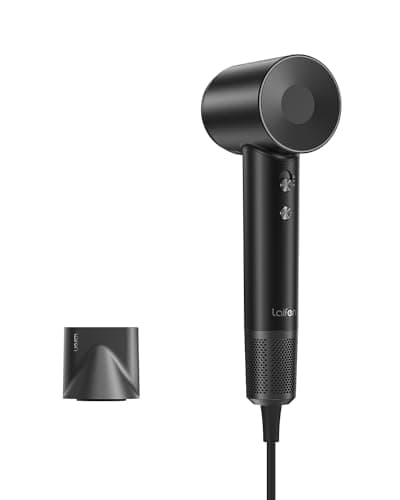 Laifen Swift High-Speed Hair DryerA 110,000 rpm brushless motor moving air at 22.3 m/s, which dries by air speed rather than temperature. That trade is the entire argument for high-speed dryers. Laifen Swift High-Speed Hair DryerA 110,000 rpm brushless motor moving air at 22.3 m/s, which dries by air speed rather than temperature. That trade is the entire argument for high-speed dryers. | Cutting drying time without cranking the heat | High-speed brushless dryer | |
| 2 | No photoT3 Fit Compact Hair DryerThirty percent smaller and twenty percent lighter than a full-size dryer, which makes it the short-hair and small-bathroom answer rather than a downgrade. | A small dryer that is not a travel compromise | Compact ionic dryer | Check price#ad |
| 3 | 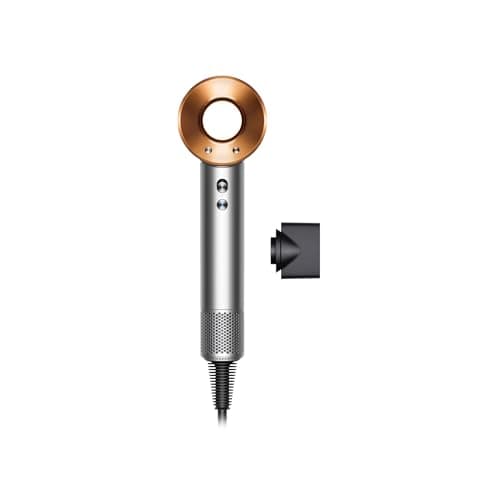 Dyson Supersonic Origin Hair DryerThe one dryer that tells you what each heat setting actually is in degrees, which makes it the only one in the category you can plan a routine around. Dyson Supersonic Origin Hair DryerThe one dryer that tells you what each heat setting actually is in degrees, which makes it the only one in the category you can plan a routine around. | Published temperatures on every heat setting | 1,600W dryer | |
| 4 | 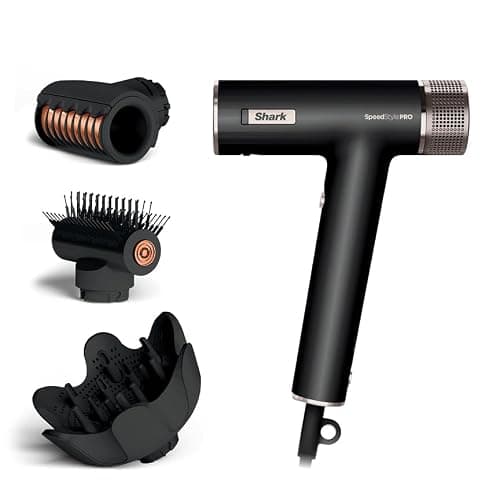 Shark SpeedStyle Pro Ionic Dryer (HD732)The rare dryer that publishes the numbers that matter: every heat setting in degrees, plus a ceiling it says it never exceeds at 230F, which is below every damage threshold in the literature. Shark SpeedStyle Pro Ionic Dryer (HD732)The rare dryer that publishes the numbers that matter: every heat setting in degrees, plus a ceiling it says it never exceeds at 230F, which is below every damage threshold in the literature. | A published temperature ceiling you can actually check | High-velocity dryer |
#1 · Cutting drying time without cranking the heat
Laifen Swift High-Speed Hair Dryer
A 110,000 rpm brushless motor moving air at 22.3 m/s, which dries by air speed rather than temperature. That trade is the entire argument for high-speed dryers.
| Motor | 110,000 rpm brushless motorsource |
|---|---|
| Air speed | 22.3 m/ssource |
| Rated power | 1,400Wsource |
| Voltage | 120V — Laifen states plainly that it is not dual voltagesource |
| Heat regulation | Thermo-Control microprocessor monitors air temperature 100 times per second and alternates hot and cold airstreamssource |
| Ions | 200 million negative ionssource |
| Noise | 59 dBsource |
| Weight | 0.9 lb / 407 gsource |
| In the box | Dryer, one magnetic smooth nozzle, manual — no diffusersource |
What those numbers mean
Air speed and heat are two different ways to get water out of hair, and only one of them denatures protein. A dryer that moves air at 22.3 m/s can finish the job at a lower temperature, which is the whole reason this category exists.
0.9 lb is less than half the weight of the AC dryers it competes with. Over a fifteen-minute blowout on long hair that is the difference between finishing properly and giving up damp.
59 dB is a published figure, which almost no dryer brand offers. For context, that is conversational-speech territory rather than the vacuum-cleaner range most 1,875W dryers occupy.
What it does well
- Dries by air speed, so the heat setting can stay lower for the same result
- 0.9 lb, the lightest serious dryer in this roundup
- Publishes both an air-speed and a noise figure, which the mass market does not
- Temperature sampled 100 times a second
What it does not
- No air temperature in degrees — the settings are named hot, warm and cold
- 120V only. Laifen states it is not dual voltage, so it cannot travel abroad
- Only the smooth nozzle is in the box; the diffuser is a separate purchase
- The magnetic nozzles are proprietary; nothing else fits
- The narrow high-velocity stream takes practice on a big head of hair
Skip this one if: Skip it if you diffuse curls and want a wide, gentle airflow. A high-velocity stream is the opposite of what a curl pattern wants, and the diffuser is a separate purchase here rather than something in the box.
photo
#2 · A small dryer that is not a travel compromise
T3 Fit Compact Hair Dryer
Thirty percent smaller and twenty percent lighter than a full-size dryer, which makes it the short-hair and small-bathroom answer rather than a downgrade.
| Size | 30 percent smaller and 20 percent lighter than a full-size hair dryersource |
|---|---|
| Settings | 3 heat and 2 speed settingssource |
| Cool shot | Lock-in cool shotsource |
| Ion technology | T3 IonAir, a wide and gentle ion-infused airstreamsource |
What those numbers mean
The size claims are relative to T3's own full-size dryers, which is how the manufacturer states them. Treat them as a comparison inside the T3 line rather than an absolute measurement.
A lock-in cool shot matters more than a momentary one. Cold air is what sets a style, and holding a button for the last thirty seconds of every section is how people give up on it.
T3 does not publish a wattage for the Fit. That is a real gap in the disclosure and it is why this is not the pick when raw drying power is the requirement.
What it does well
- Genuinely compact without dropping to travel-dryer performance
- Lock-in cool shot rather than a held button
- Wide airstream suits shorter hair and fringe work
What it does not
- T3 publishes no wattage, no temperature and no airflow figure for this model
- Three heat settings is a coarse grid
- Compact size limits how much hair it can handle at once
Skip this one if: Skip it if your hair is long and thick. Compact means a smaller barrel and less air moved per second, and on a big head of hair that reads as a slow dry.
#3 · Published temperatures on every heat setting
Dyson Supersonic Origin Hair Dryer
The one dryer that tells you what each heat setting actually is in degrees, which makes it the only one in the category you can plan a routine around.
| Power | 1,600W at full powersource |
|---|---|
| Heat settings | 4 settings — 212F (100C), 176F (80C), 140F (60C), and constant coldsource |
| Speed settings | 3 — fast drying, regular drying, gentle dryingsource |
| Airflow | Up to 41 liters per secondsource |
| Heat regulation | Measures air temperature over 40 times a secondsource |
| Dimensions | 9.6 in long, 3.9 in wide, 3.1 in deepsource |
What those numbers mean
Four heat settings published as 212F, 176F and 140F plus cold is the disclosure the rest of the category refuses to make. It means you can pick a setting against a damage threshold instead of against a vague label.
Note where those numbers sit. Even the hottest setting, 212F, is below the 302F figure Shark names as its damage line and far below the temperatures at which the literature reports cuticle degradation.
1,600W is less nominal power than a US 1,875W dryer, and 41 l/s of airflow is how it compensates. Again: air speed, not temperature.
What it does well
- Publishes an actual temperature for every heat setting, uniquely in this category
- Airflow figure published in liters per second
- Top setting of 212F is below every damage threshold in the cited research
- Attachments attach magnetically and can be changed mid-dry
What it does not
- Costs several times what a competent 1,875W dryer costs
- 1,600W nominal will feel slower than an AC dryer on very thick hair
- Dyson does not sell through every retailer, so availability moves around
Skip this one if: Skip it if the budget is the constraint rather than the information. Everything the Supersonic does for hair health can be approximated by running a cheaper dryer on medium heat and high speed, which costs nothing.
#ad · how this is funded · price as of October 25, 2026
#4 · A published temperature ceiling you can actually check
Shark SpeedStyle Pro Ionic Dryer (HD732)
The rare dryer that publishes the numbers that matter: every heat setting in degrees, plus a ceiling it says it never exceeds at 230F, which is below every damage threshold in the literature.
| Heat settings | Three published settings — low 65C, medium 80C, high 100C — plus a cool shot and a permanent cool modesource |
|---|---|
| Temperature ceiling | Measures and regulates temperature 1,000 times a second, never exceeding 230F, and never approaching 302Fsource |
| Power | 1,600 watts at 120 voltssource |
| Weight | 1.674 lbsource |
| Noise | About 83 decibelssource |
| Cord | Approximately 8 ftsource |
| Scalp Shield mode | Reduces air temperature to a level Shark states is optimized for scalp comfort and root drying, developed with dermatologistssource |
| Attachments | Three accessories per dryer, chosen from the DefrizzFast diffuser, QuickSmooth brush, Express Touchup brush, Lift & Stretch wide-tooth comb, Turbo concentrator and FrizzFighter finishing toolsource |
What those numbers mean
A stated ceiling of 230F is the single most useful specification on any dryer, and almost nobody publishes one. It puts the airflow well under the 302F figure Shark itself names as the damage line and far under the cuticle-degradation range in the research.
Shark also names each setting in degrees — 65C, 80C and 100C — which is disclosure the rest of the category mostly refuses. It means you can pick a setting against a damage threshold rather than against an unlabeled dial, and note that even the top setting lands under that 230F ceiling.
The accessory list is a choice rather than a fixed bundle, which matters more than it sounds. The DefrizzFast diffuser is the attachment that earns this dryer its place on curly and coily pages, so check it is one of the three in the configuration you buy.
What it does well
- Publishes a temperature ceiling AND every heat setting in degrees
- Published wattage, weight, cord length and even a decibel figure
- Regulates 1,000 times a second, the same control loop as the FlexStyle
- Scalp Shield mode is aimed squarely at root drying on fragile new growth
What it does not
- Shark publishes no airflow figure, so drying speed cannot be checked on paper
- 1,600W is less power than an 1,875W AC dryer, and the low ceiling compounds that
- Three accessories is a choice, so the diffuser is not guaranteed to be in the box
- The retail listing says 1,750W where Shark's own support article says 1,600W
Skip this one if: Skip it if you want maximum heat for a fast, poker-straight blowout on coarse hair. The ceiling that protects fragile hair is the same ceiling that will frustrate you here.
#ad · how this is funded · price as of October 25, 2026
What 59 dB actually means
A decibel figure on its own is hard to place, so here is the context. The scale is logarithmic: every 10 dB roughly doubles perceived loudness, which means small-looking numeric gaps are large real ones.
| Level | Comparable to |
|---|---|
| 40 dB | A quiet library, a fridge humming |
| 59 dB | Laifen's published figure for the Swift — conversational speech |
| 60-70 dB | Normal conversation, a dishwasher |
| 70-80 dB | A vacuum cleaner. Where most full-size dryers sit by reputation |
| 83 dB | SharkNinja's published figure for the SpeedStyle Pro — above that band |
| 85 dB+ | The level at which sustained occupational exposure becomes a hearing concern |
59 dB sitting in conversational-speech territory is genuinely notable for a hair dryer, and the 24 dB gap to the Shark's published 83 dB is far larger than it looks on a logarithmic scale. The important caveat applies to both: these are manufacturer-stated figures measured under conditions neither company publishes, so they are claims rather than independent measurements, and there is no common test standard to compare them against each other. We are reporting them as Laifen's and Shark's own numbers, which is what they are.
Why high-speed motors are quieter, and it is not the volume
The useful thing to understand is that a dryer's perceived loudness is largely about pitch and turbulence rather than raw sound pressure. An AC motor produces a low, broadband roar. A high-speed brushless motor spinning at 110,000 rpm produces a higher-frequency sound with less low-end rumble — and while high frequencies are not inherently quieter, they are far easier to tune, dampen and enclose.
That is why the two picks with published high-speed motor figures lead the inference side of this list. Laifen publishes 110,000 rpm; Dyson publishes a 13-blade impeller. Blade count matters here too — an odd or unusual blade count spreads the acoustic energy across more frequencies rather than concentrating it in one tone, which is the standard engineering approach to making a fan sound less annoying at the same volume.
The variable you control, which beats the purchase
Noise scales steeply with fan speed. Dropping from the top speed to the middle one cuts perceived loudness far more than switching dryers usually does — and on most hair it costs very little drying time, because you can compensate with better sectioning.
- Run the middle fan speed, not the top one. The single biggest change available, and it is free.
- Section the hair. Drying the whole head at once means the outer layer finishes while the interior stays wet, which is what makes sessions long. Four clipped sections typically halves the time — and halving the time halves the noise exposure.
- Squeeze out more water first, with a microfiber towel or cotton t-shirt rather than terry. Less water is less drying.
- Use a concentrator. Directed air dries a section faster than undirected air, so the session is shorter.
- Close the door. Obvious, and it does more than any specification on this page.
If a shared space is the real problem
The compact dryers are worth a specific mention. A smaller barrel moves less air and makes less noise, and on short or fine hair that is a fair trade. The T3 Fit is 30 percent smaller and 20 percent lighter than a full-size dryer by T3's own comparison, and on a bob or a fringe there is no drying penalty worth caring about.
For long or dense hair the trade stops working — a compact dryer means a much longer session, and a long quiet session can be worse for a sleeping household than a short loud one. Dryers for thick hair covers that side, and travel dryers covers the compact category properly.
Related
The dryers hub has the full ranking, professional dryers explains why AC motors are the loud ones, and dryers for fine hair covers the low-power tools that are quiet as a side effect.
Questions people actually ask
What is the quietest hair dryer?
Two dryers in our roster have a published decibel figure: the Laifen Swift at a stated 59 dB - conversational-speech territory - and the Shark SpeedStyle Pro at about 83 dB, which is vacuum-cleaner territory. Every other manufacturer we cover publishes nothing at all, so any ranking that lists ten dryers by loudness is either measuring them independently or guessing. We do not measure, so we report the two numbers that exist.
How many decibels is a quiet hair dryer?
Under about 60 dB is genuinely quiet for this category - roughly the level of normal conversation. Most full-size dryers sit in the 70-80 dB range by reputation, which is vacuum-cleaner territory. Bear in mind the scale is logarithmic: every 10 dB roughly doubles perceived loudness, so a 10-point gap is much larger than it looks.
Why are hair dryers so loud?
Two sources: the motor and the air itself. Air forced through a narrow nozzle at speed is turbulent, and turbulence is noise - which is why the sound rises steeply with fan speed. AC motors, the type salon dryers use for durability, add a low broadband roar on top. High-speed brushless motors produce a higher-frequency sound that is easier to dampen.
Are brushless hair dryers quieter?
There is good reason to expect so, and one published figure supports it - Laifen's brushless Swift at a stated 59 dB. The engineering logic is that high-frequency sound from a fast-spinning impeller is easier to tune and dampen than the low-end rumble of an AC motor. That is principle applied to published motor specs rather than a measurement of these dryers, and we are not going to overstate it.
How can I make my hair dryer quieter?
Run the middle fan speed instead of the top one - noise scales steeply with airflow and this is the single biggest change available. Then shorten the session: section the hair into four parts, squeeze out more water with a microfiber towel first, and use a concentrator so each section dries faster. Shorter session, less total noise, no purchase required.
Can a hair dryer be quiet AND powerful, or is that a trade-off?
It is a real trade-off and there is one way around it. Noise in a dryer comes mostly from air forced through a nozzle at speed, so loudness tracks airflow rather than wattage - which means you cannot have maximum airflow quietly. What you CAN have is the same drying speed at lower noise by using air velocity instead of heat and volume: the Laifen Swift publishes 59 dB alongside a 110,000 rpm brushless motor, which is how one tool holds both ends. The other half of the answer is free: a concentrator nozzle directs the air so a section finishes faster, so the dryer runs for less time at any given noise level.
Which hair dryer is best for a home office, a shared flat or a hotel room?
The two specifications that matter are a published decibel figure and a small physical footprint, and only the Laifen Swift publishes the first - a stated 59 dB, roughly conversational speech. For thin walls or an early start, the practical answer is the quietest dryer you can find plus the middle fan speed rather than the top one, which is the single biggest reduction available on any dryer. If the room is a hotel one, the voltage rating matters as much as the noise: travel and dual voltage dryers covers which tools can leave the country at all.
I need to dry my hair without waking anyone up. What actually works?
Four things, in order of how much they help. Use the middle fan speed, not the top one, because noise scales steeply with airflow. Squeeze more water out with a microfiber towel first, so the dryer runs for less time. Fit the concentrator, so each section finishes faster. And close the door - at these frequencies a closed door does more than a quieter dryer does. If you are buying for this specifically, the Laifen Swift is the only dryer on this page with a published figure (59 dB), and a blow-dry brush is quieter again than any standalone dryer because it runs at far lower wattage in contact with the hair.
Sources
Every figure on this page traces to one of these. If a number here disagrees with the manufacturer, the manufacturer is right and we want to know — tell us.
Read next
Best Overall
The Best Hair Dryers, Chosen by Hair Type
Nine dryers compared on published wattage, airflow and temperature ceilings, then routed to the hair type each one genuinely suits.
Top pick: Laifen Swift High-Speed Hair Dryer
Best Professional
The Best Professional Hair Dryers
Four salon-grade dryers ranked on motor type, published power and serviceability - and what the word professional does and does not guarantee.
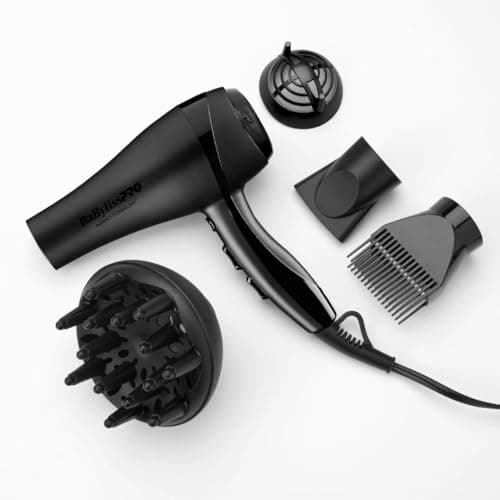
Top pick: BaBylissPRO Nano Titanium Dryer (BNT5548)

Best for Fine Hair
The Best Hair Dryers for Fine and Thin Hair
Five dryers for fine and thin hair, ranked on published temperature ceilings and weight rather than on wattage nobody needs.
Top pick: Shark SpeedStyle Pro Ionic Dryer (HD732)

Best for Travel
The Best Travel Hair Dryers
Four travel dryers ranked on genuine dual-voltage support, folded size and published power — with the adapter-versus-converter mistake explained.
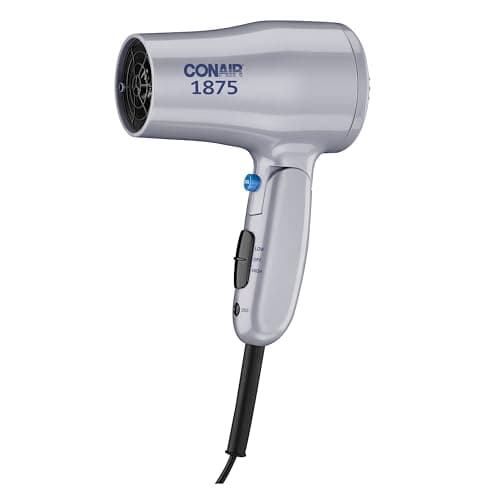
Top pick: Conair Compact Folding-Handle Dryer (127NPN)
Supersonic Verdict
Dyson Supersonic Review
The Supersonic read from its published specifications, including the combined temperature and airflow disclosure nothing else in the category matches.
Top pick: Dyson Supersonic Origin Hair Dryer
Attachment Guide
Hair Dryer Attachments Explained
What each dryer attachment actually does, which hair type needs which, and which dryers include the one you need.
Top pick: Conair InfinitiPro 1875W Salon Performance AC Motor Dryer (259BDNRY)