BaBylissPRO vs CHI Flat Iron
Two salon irons at a similar price that disagree about almost everything. The disagreement is the useful part.
How this page is funded: the buy links below are affiliate links, and Heat Index earns a commission on qualifying purchases at no cost to you. Nothing on this page was supplied by a manufacturer, and commission plays no part in the ranking — read the full disclosure. Picks are chosen from published specifications, not from hands-on testing; the method is written down so you can check it. Prices last verified October 24, 2026.
These two irons are frequently shortlisted together, cost roughly the same, and are built on opposite philosophies. One gives you fifty temperature settings up to 450F on titanium plates; the other gives you a single fixed 392F on ceramic and no dial at all.
Neither is the upgrade. They suit different hair, and the fastest way to choose is to answer one question about yours.
The published specifications, side by side
| BaBylissPRO Nano Titanium | CHI Original (GF1001) | |
|---|---|---|
| Plate material | Titanium | Ceramic |
| Plate width | 1 inch | 1 inch |
| Plate length | Extra-long 5 inches | Not published |
| Temperature | 50 heat settings, up to 450F | Pre-set 392F, not adjustable |
| Heater | Dual-voltage ceramic heater, rapid heat-up and recovery | Not published |
| Heat-up time | Under one minute (owner's manual) | Not published |
| Housing | Ryton, to resist high heat | Not published |
| Ions | Emits negative ions | Not published |
| Cord | 9 ft swivel | 11 ft swivel |
| Weight | Not published | 1.4 lb |
| Voltage | Dual voltage | Dual voltage |
| Warranty | Limited 4-year | 2-year limited |
The BaBylissPRO publishes more of what matters for straightening — plate length, heater behavior, housing material — while the CHI publishes more of what matters day to day: heat-up time, weight and a longer cord. Neither publishes everything.
Quick picks
Ranked, with the reasoning underneath. Tap any row to jump to that write-up; tap the price to check it on Amazon. Prices come from the live layer, never from this page.
| # | Product | Best for | Type | Price |
|---|---|---|---|---|
| 1 | 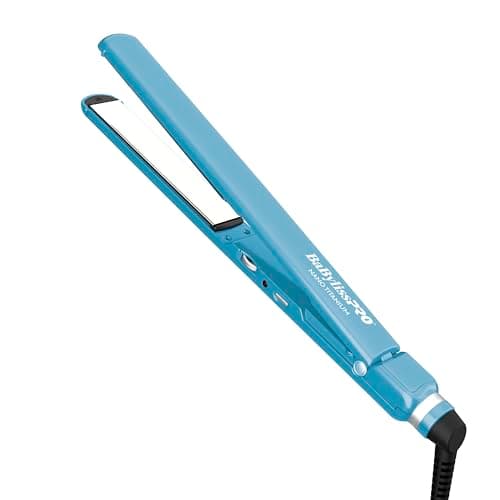 BaBylissPRO Nano Titanium 1-inch Ultra-Thin StraightenerFifty heat settings from 240F to 450F on extra-long 5-inch titanium plates — the reach coarse hair needs, and a floor low enough for fine hair if you trust yourself with the dial. BaBylissPRO Nano Titanium 1-inch Ultra-Thin StraightenerFifty heat settings from 240F to 450F on extra-long 5-inch titanium plates — the reach coarse hair needs, and a floor low enough for fine hair if you trust yourself with the dial. | Thick or coarse hair that needs one pass, not four | Titanium iron, 50 settings | |
| 2 | 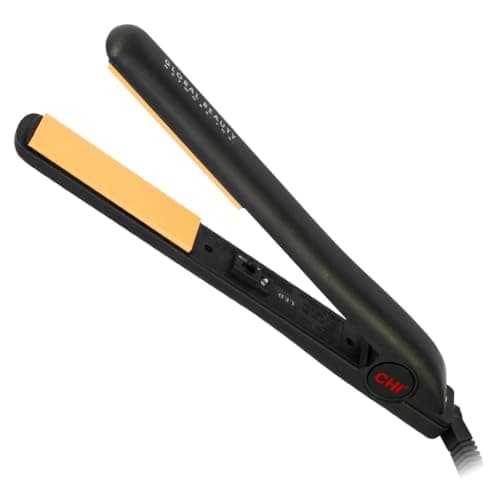 CHI Original 1-inch Ceramic Hairstyling Iron (GF1001)A single preset of 392F and no dial at all, which removes the most common way people damage their hair: turning it up because the first pass did not work. CHI Original 1-inch Ceramic Hairstyling Iron (GF1001)A single preset of 392F and no dial at all, which removes the most common way people damage their hair: turning it up because the first pass did not work. | One fixed, sensible temperature and nothing to get wrong | Single-temperature ceramic iron |
#1 · Thick or coarse hair that needs one pass, not four
BaBylissPRO Nano Titanium 1-inch Ultra-Thin Straightener
Fifty heat settings from 240F to 450F on extra-long 5-inch titanium plates — the reach coarse hair needs, and a floor low enough for fine hair if you trust yourself with the dial.
| Plates | 1-inch wide, extra-long 5-inch platessource |
|---|---|
| Temperature | 50 heat settings, up to 450Fsource |
| Heater | Dual-voltage ceramic heater for rapid heat-up and recoverysource |
| Housing | Ryton, to resist high heatsource |
| Ions | Emits negative ionssource |
| Cord | 9 ft swivel cordsource |
| Warranty | Limited 4-year warrantysource |
What those numbers mean
Plate length is the specification nobody markets and everybody should. Five inches of plate covers more hair per pass, which means fewer passes, which is the only heat-damage variable fully in your control.
Fifty settings is not gimmickry when the range runs to 450F. It means you can sit at 320F or 340F precisely rather than choosing between a low, medium and high that nobody has defined.
Titanium conducts heat faster than ceramic and recovers faster after a cold section of hair pulls the temperature down. That is genuinely useful on coarse hair and genuinely dangerous on fine hair.
What it does well
- Extra-long 5-inch plates mean fewer passes on long hair
- Fifty discrete settings, so a low temperature is actually selectable
- Fast titanium heat recovery mid-section
- Four-year warranty and a 9-foot cord
What it does not
- 450F is above every threshold in the research and should not be used
- Titanium's fast heat transfer is unforgiving of a slow hand
- No auto shut-off — the manual warns it burns out if left on, voiding the warranty
Skip this one if: Skip it if you are the kind of person who reaches for the maximum setting. Fifty settings only helps if you use the low ones, and the top of this range is a number no hair needs.
#2 · One fixed, sensible temperature and nothing to get wrong
CHI Original 1-inch Ceramic Hairstyling Iron (GF1001)
A single preset of 392F and no dial at all, which removes the most common way people damage their hair: turning it up because the first pass did not work.
| Temperature | Pre-set 392F (202C), not adjustablesource |
|---|---|
| Plates | 1-inch ceramic floating platessource |
| Cord | 11 ft swivel cordsource |
| Voltage | Dual voltagesource |
| Weight | 1.4 lbsource |
| Warranty | 2-year limited warrantysource |
What those numbers mean
A fixed 392F is a design decision with a real argument behind it. It sits above the range dermatological guidance points fine hair toward and below the 450F that irons advertise, so it is a defensible single answer for medium and coarse hair.
It is also the reason this iron is wrong for fine or bleached hair. There is no way to turn it down, and 392F on hair that snaps when you brush it wet is not a setting anyone should be using.
An 11-foot cord is the longest here and it changes where you can stand. Combined with dual voltage, this is a genuinely travel-capable professional iron.
What it does well
- One temperature means one fewer way to damage your hair
- 11-foot swivel cord, the longest in this roundup
- 1.4 lb, with the weight published
- Dual voltage
What it does not
- No temperature control at all, which rules out fine and fragile hair
- Ceramic plates heat more slowly than titanium on coarse hair
- No auto shut-off published
- CHI publishes no heat-up time, only a "flash-quick heating" claim
Skip this one if: Skip it if your hair is fine, bleached or already breaking. A locked 392F cannot be turned down, and this is exactly the temperature that hair should not be seeing.
Titanium against ceramic, which is the real difference
Plate material is not a quality tier. It is a decision about how fast heat moves from the plate into the hair, and each answer is right for one hair type and wrong for the other.
When a cold, dense section meets a hot plate, the plate loses heat into it. Titanium conducts heat quickly in both directions, so it re-reaches its set point before the pass finishes. Ceramic conducts more slowly, so on a long coarse section the plate is measurably cooler at the end than at the start — which shows up as the last two inches never quite straightening, and then a second pass over hair that has already been heated once.
total exposure = temperature x contact time x passes
one pass at 380F beats two passes at 360F
Passes are the exposure variable most under your control, and heat recovery is what decides how many you need. On coarse hair titanium is frequently the LESS damaging choice for exactly this reason - which inverts the usual assumption that the gentler-sounding material is the safer one.
The same property reverses on fine hair. Titanium's speed means heat arrives faster than a hesitant hand can move, and a fine strand has less mass to absorb it. That is why the fine hair page recommends ceramic and this comparison does not recommend either iron for it. There is a full breakdown in ceramic versus titanium.
Fifty settings against no settings
This is the other axis of disagreement, and both positions are defensible.
- The BaBylissPRO's case: fifty discrete settings across a range topping out at 450F means you can sit precisely at 320F or 340F rather than choosing between an undefined low, medium and high. Precision is genuinely useful if you use it — the BaBylissPRO Nano Titanium review maps every setting to degrees from the owner's manual.
- The CHI's case: a fixed 392F removes the single most common way people damage their hair, which is turning the dial up because the first pass did not work. There is no dial. You cannot make that mistake.
- The BaBylissPRO's risk: 450F is above every threshold in the published research — cortex damage is reported from around 392F. Fifty settings only helps if you use the low ones, and the top of that range is a number no hair needs.
- The CHI's risk: 392F is *at* the cortex-damage threshold and cannot be reduced. For fine or bleached hair that is disqualifying, and no technique works around it.
The details that decide it in practice
Two published specifications get overlooked and are worth more than they sound.
Plate length. The BaBylissPRO publishes extra-long 5-inch plates; CHI publishes no length at all. Length decides how much hair each pass covers, which decides how many passes a long section needs — and passes are the damage. On long hair this is a real advantage and it is almost never discussed, because almost nobody publishes the figure.
Cord length. CHI publishes 11 feet against the BaBylissPRO's 9. That sounds trivial until you are standing where the mirror is rather than where the outlet is. Combined with a published 1.4 lb weight and dual voltage, the CHI is the more travel-capable of the two — which is why it leads our travel flat irons page.
The verdict, with a buyer attached
Buy the BaBylissPRO if your hair is coarse, dense, curly or 4C, or if it is long enough that plate length matters. The titanium recovery and the 5-inch plates are both aimed at finishing a section in one pass, and on that hair type one pass is the whole game. The four-year warranty is the longest here. Ignore the top twenty settings.
Buy the CHI if your hair is medium or wavy and healthy, if you want to stop thinking about temperature, or if you travel and value an 11-foot cord and a published weight. A single well-chosen temperature is a genuine feature for anyone who has been guessing at a dial.
Buy neither if your hair is fine, bleached or breaking. The CHI's 392F cannot be turned down and the BaBylissPRO's titanium plates are unforgiving on a fine strand. The HSI Glider publishes a 140F floor and the ghd Platinum+ holds 365F precisely — both are better answers, and one of them is considerably cheaper than either iron here.
Questions people actually ask
Is BaBylissPRO or CHI better?
Neither in general - they suit different hair. The BaBylissPRO's titanium plates recover heat fast, which coarse dense hair needs to finish a section in one pass, and it publishes extra-long 5-inch plates. The CHI's fixed 392F ceramic is gentler and removes the temptation to turn the dial up, which suits medium and wavy hair. For fine or bleached hair, neither is the right answer.
Should I get titanium or ceramic plates?
Titanium for coarse, dense or resistant hair, because it recovers its set temperature quickly after a cold section pulls it down - which means one pass instead of two, and passes are the real exposure. Ceramic for fine, damaged or color-treated hair, because slower and more even heat transfer is forgiving. It is a heat-transfer decision, not a quality tier.
Is the CHI flat iron hot enough for thick hair?
Its fixed 392F is a sensible working temperature for coarse hair on paper. The practical problem is ceramic's slower heat recovery: on a long dense section the plate cools through the pass and the last two inches come out under-straightened, so you end up doing a second pass. The BaBylissPRO's titanium plates address exactly that.
Does the CHI flat iron have temperature settings?
No. It is a pre-set 392F with no adjustment at all. That is a deliberate design decision - it removes the most common way people damage their hair, which is raising the temperature when a pass does not take - but it also means the iron cannot be used on fine or bleached hair, where the working range is 250-300F.
Which is better for travel, BaBylissPRO or CHI?
The CHI, on published specifications. Both are dual voltage, but the CHI publishes an 11-foot swivel cord against the BaBylissPRO's 9 and a 1.4 lb weight where BaBylissPRO publishes no weight at all. A long cord matters more in a hotel bathroom than anywhere else.
Is 450F too hot for a flat iron?
It is above every threshold in the published research - cuticle degradation is reported from around 302F and cortex damage from around 392F. The BaBylissPRO's 450F maximum exists to win spec-sheet comparisons rather than because hair needs it. If a section is not straightening in one pass, the fix is a thinner section or drier hair, not more heat.
Sources
Every figure on this page traces to one of these. If a number here disagrees with the manufacturer, the manufacturer is right and we want to know — tell us.
- BaBylissPRO Nano Titanium 1-inch ultra-thin straightener (BNT4072TUC)
- BaBylissPRO Nano Titanium ultra-thin straightener owner's manual (BNT4072TUC / BNT4073TUC / BNT4074TUC)
- CHI 1-inch original ceramic hairstyling iron (GF1001)
- Thermal-induced changes in cuticle and cortex of chemically treated hair, PubMed Central
- Thermal denaturation and structural changes of alpha-helical proteins in keratins, Journal of Structural Biology
Read next
Compare
Head-to-Head Comparisons
Spec-by-spec comparisons of the hair and grooming tools people are genuinely choosing between, with both options priced live.
Top pick: Dyson Airwrap i.d. Multi-Styler and Dryer
Best Overall
The Best Hair Straighteners and Flat Irons
Six flat irons compared on plate material, plate length and published temperature range, then matched to hair type.
Top pick: ghd platinum+ Styler
Plate Material Guide
Ceramic vs Titanium Flat Irons
The plate material decision explained by heat transfer rather than price, with which material suits which hair type and why.
Top pick: BaBylissPRO Nano Titanium 1-inch Ultra-Thin Straightener
Best Ceramic Iron
The Best Ceramic Flat Irons
Four ceramic flat irons ranked on published temperature range and control precision - and an honest account of where ceramic is the wrong choice.
Top pick: ghd platinum+ Styler
Best for Thick Hair
The Best Flat Irons for Thick Hair
Five flat irons for thick and coarse hair, ranked on plate length and heat recovery — the two specs that cut pass count.
Top pick: BaBylissPRO Nano Titanium 1-inch Ultra-Thin Straightener

ghd Verdict
ghd Platinum+ Styler Review
The ghd Platinum+ read from its published specifications: why a fixed 365F beats an adjustable 450F, and the buyer who should skip it.
Top pick: ghd platinum+ Styler