Panasonic ARC5 Review
Five blades and the highest published cutting rate of any shaver on this site. On dense, coarse growth that is the specification that matters; on light stubble it is width and cost you did not need.

How this page is funded: the buy links below are affiliate links, and Heat Index earns a commission on qualifying purchases at no cost to you. Nothing on this page was supplied by a manufacturer, and commission plays no part in the ranking — read the full disclosure. Picks are chosen from published specifications, not from hands-on testing; the method is written down so you can check it. Prices last verified October 22, 2026.
If your growth is dense and coarse, this is the shaver to buy, and the reason is one number: 70,000 cross cuts per minute, the highest published cutting rate of any shaver on this site. If your growth is light and you shave daily, buy something narrower and cheaper — five blades are engineered for density, and on fine sparse stubble the extra blades add width and cost for no benefit.
That is an unusually clean verdict for a premium shaver, and it is clean because Panasonic publishes the figures to support it. Most of this category sells adjectives. This one sells a motor speed, a cutting rate and a blade count, and all three point at the same buyer.
Every published specification
| Specification | Published figure |
|---|---|
| Motor | 14,000 cpm linear motor |
| Cutting rate | Five-blade system delivering up to 70,000 cross cuts per minute |
| Blades | Five outer foils with ultra-sharp inner blades, stated to capture, hold and cut whiskers at the base |
| Materials | Hypoallergenic stainless steel foils and blades, stated to minimize irritation |
| Battery runtime | Not published for this configuration |
| Charge time | Not published |
| Weight | Not published |
| Head flexibility in degrees | Not published |
Four blanks on a premium product, and the first one is the conspicuous one: no published battery runtime. Braun publishes a Clean & Charge station and a full cleaning cycle; Philips publishes seven years of motor and battery lifetime. Panasonic publishes a cutting rate and not a runtime, which tells you what it thinks you are buying.
Quick picks
Ranked, with the reasoning underneath. Tap any row to jump to that write-up; tap the price to check it on Amazon. Prices come from the live layer, never from this page.
| # | Product | Best for | Type | Price |
|---|---|---|---|---|
| 1 | 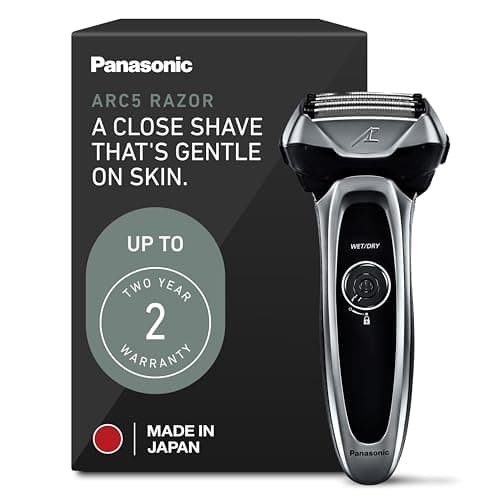 Panasonic ARC5 Advanced 5-Blade Electric ShaverA 14,000 cpm linear motor driving five blades to 70,000 cross cuts a minute — the highest published cutting rate here, which is what dense hair needs. | Thick, dense growth in a single pass | 5-blade foil shaver | |
| 2 | 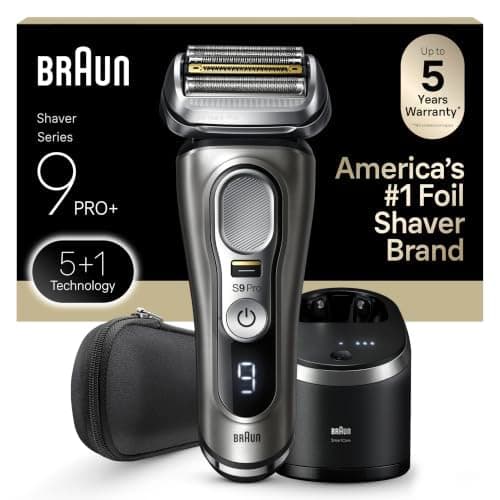 Braun Series 9 Pro Electric Shaver (9465cc)The ProLift trimmer exists specifically to catch flat-lying hair, which is the one failure mode every foil shaver shares. | Flat-lying hairs a foil shaver usually misses | Foil shaver | |
| 3 | 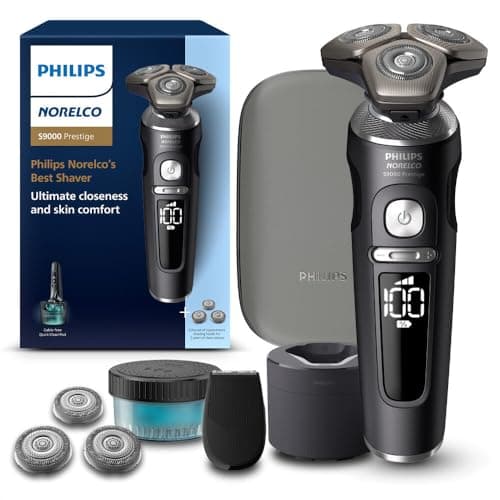 Philips Norelco Shaver S9000 Prestige (SP9840/90)A hair sensor reading 500 times a second and a stated 0.00 mm cut, which is what makes rotary work on a seven-day beard where foil shavers struggle. | A rotary shave on a longer beard | Rotary shaver |
#1 · Thick, dense growth in a single pass
Panasonic ARC5 Advanced 5-Blade Electric Shaver
A 14,000 cpm linear motor driving five blades to 70,000 cross cuts a minute — the highest published cutting rate here, which is what dense hair needs.
| Motor | 14,000 cpm linear motorsource |
|---|---|
| Cutting rate | 5-blade system delivering up to 70,000 cross cuts per minutesource |
| Blades | Five outer foils with ultra-sharp inner blades that capture, hold and cut whiskers at the basesource |
| Materials | Hypoallergenic stainless steel foils and blades to minimize irritationsource |
What those numbers mean
Five blades means five chances per pass for a hair to enter a slot. That is the whole argument for a five-blade foil on dense growth, and it is why fewer passes are needed than with a three-blade head.
A linear motor holds its speed under load. Rotary-driven shavers slow down when they hit a dense patch, which is the moment they start pulling instead of cutting.
Hypoallergenic stainless steel is a materials claim about irritation, not a medical one. If your skin reacts to shaving, this is a reasonable variable to change but it is not a treatment.
What it does well
- 70,000 cross cuts per minute, the highest published figure here
- Linear motor holds speed under load
- Five blades means fewer passes on dense growth
- Hypoallergenic stainless steel foils
What it does not
- Panasonic does not publish a battery runtime for this configuration
- Five-blade heads are more expensive to replace
- Wide head is awkward under the nose and along the jawline
Skip this one if: Skip it if your growth is light and you shave every day. A five-blade head is engineered for density, and on fine sparse stubble the extra blades add cost and width for nothing.
#ad · how this is funded · price as of October 22, 2026
#2 · Flat-lying hairs a foil shaver usually misses
Braun Series 9 Pro Electric Shaver (9465cc)
The ProLift trimmer exists specifically to catch flat-lying hair, which is the one failure mode every foil shaver shares.
| ProLift trimmer | Captures and cuts flat-lying hair using Sonic technology, stated to shave up to 10 percent fastersource |
|---|---|
| Sonic technology | 10,000 micro-vibrations per minute, delivering 40,000 cutting actions per minutesource |
| Flexibility | 40-degree flexibility to follow contourssource |
| Adaptation | AutoSense reads and adapts to beard densitysource |
| Head | Flexible ProHead cuts 1, 3 or 7-day beardssource |
| Station | 5-in-1 Clean & Charge station charges, cleans, lubricates and driessource |
| Waterproof | 100 percent waterproof, wet or drysource |
What those numbers mean
Flat-lying hair is the specific reason people give up on foil shavers. A foil has to lift a hair into a slot before it can cut it, and hairs pressed against the skin never get lifted. The ProLift trimmer is a mechanism aimed at exactly that.
The cleaning station is not a gimmick with a foil shaver. Foils clog with a paste of stubble and skin oil that a rinse does not remove, and a clogged foil shaves worse and pulls more.
The 10-percent-faster claim is Braun's own, relative to their own previous system. Read it as a within-brand comparison.
What it does well
- ProLift trimmer targets the flat-hair failure mode directly
- Cleaning station keeps foils performing, which matters more than it sounds
- Adapts to beard density automatically
- Fully waterproof, wet or dry
What it does not
- Cleaning cartridges are a recurring cost
- Foil heads suit uniform growth; multi-directional beards favor rotary
- The station takes up real counter space
Skip this one if: Skip it if your beard grows in swirls and multiple directions. Foil shavers cut in a line, and no amount of contour flex fixes hair that is lying four different ways.
#3 · A rotary shave on a longer beard
Philips Norelco Shaver S9000 Prestige (SP9840/90)
A hair sensor reading 500 times a second and a stated 0.00 mm cut, which is what makes rotary work on a seven-day beard where foil shavers struggle.
| Cutting actions | NanoTech Dual Precision blades at up to 165,000 cutting actions per minute, which Philips states cut up to 25% more hair per strokesource |
|---|---|
| Closeness | Cuts up to 0.00 mm close to the skin with the Lift & Cut systemsource |
| Adaptation | Power Adapt sensor reads hair 500 times per second and adapts cutting powersource |
| Contours | SkinIQ adapts to every contour of the face, even on a 7-day beardsource |
| Suspension | Ultraflex Suspension System, for hair on the neck and upper lipsource |
| Lifetime | 7 years of motor and battery lifetimesource |
| Wet and dry | Wet or dry use, including with gel or foam in the showersource |
| In the box | Shaver, precision trimmer, premium pouch, Quick Clean Pod with cartridge, cleaning brush and a spare set of bladessource |
What those numbers mean
Rotary and foil are different tools for different faces. Rotary heads move in circles and cope with hair growing in several directions; foil heads cut in a line and are better on flat planes with uniform growth.
A sensor reading hair 500 times a second is what stops a rotary shaver bogging down in a dense patch and then over-shaving a sparse one. It is the specification that separates this from a cheap rotary.
Philips quotes a lifetime rather than a runtime here — seven years of motor and battery — which is the more useful number of the two. A runtime tells you how long one charge lasts; a lifetime tells you when the tool stops being worth recharging.
What it does well
- Handles multi-directional growth and a long beard without pre-trimming
- Hair sensing 500 times per second
- Wet or dry, usable with foam in the shower
- Stated 0.00 mm closeness
- A spare set of blades is in the box
What it does not
- Rotary heads suit curved faces; a flat, uniform beard is foil territory
- Premium price for the Prestige tier
- Philips publishes a 7-year lifetime but no runtime or charge time for this model
Skip this one if: Skip it if you shave daily and your growth is short and uniform. A foil shaver will be closer and faster on that face, and you would be paying for adaptation you never trigger.
#ad · how this is funded · price as of October 22, 2026
What five blades actually do
A foil shaver has to lift a hair into a slot before it can cut it, and that is the whole mechanism. Every pass is a series of chances for a hair to enter a slot, and the number of slots per pass is the blade count.
hairs cut per pass = slots per pass x chance a hair enters a slot
five blades = five chances per pass, versus three on a three-blade head
On sparse growth the chance term is already high enough that three slots get nearly everything, so a fourth and fifth add little. On dense growth the hairs compete for slots and the extra two change the outcome - which is why this is a density specification rather than a quality tier, and why the honest advice to someone with light stubble is to spend less.
The second half of the argument is the motor. Panasonic publishes a 14,000 cpm linear motor, and the word that matters is linear: it holds its speed under load. A motor that slows when it hits a dense patch is the moment a shaver starts pulling instead of cutting, and pulling is both uncomfortable and the mechanical injury behind most post-shave irritation — how to shave without razor bumps or ingrown hairs covers that properly.
Do not read 70,000 across brands
What IS comparable across the three is the mechanism question, and it is decided by your face rather than by the spec sheet. Foil cuts in a line and suits flat planes with hair growing broadly one way. Rotary moves in circles and copes with multi-directional growth and curved surfaces. Foil versus rotary is the five-second test that settles it, and if your beard grows in swirls the ARC5's cutting rate will not rescue it.
The coarse-beard case, in detail
Coarse growth fails a shaver in three specific ways, and the ARC5 has a published answer to two of them.
| The failure | What causes it | The ARC5's published answer |
|---|---|---|
| Too many passes | Not enough hairs enter a slot per pass, so you go over the same area repeatedly - and passes, not closeness, are what irritate skin | Five blades, 70,000 cross cuts a minute |
| Pulling in dense patches | The motor slows under load and the blade drags the hair instead of cutting it | A 14,000 cpm linear motor, which holds speed under load |
| Hairs lying flat against the skin | A foil cannot lift what is already pressed down - this is the one failure every foil shaver shares | Nothing published. Braun's ProLift trimmer is a mechanism aimed specifically at this, and the ARC5 does not have an equivalent |
That third row is the honest gap, and it is the reason the Braun is on this page. Flat-lying hair is the specific reason people give up on foil shavers, and Braun's ProLift trimmer exists to catch it — Braun states it shaves up to 10 percent faster as a result. If your problem is a few stubborn hairs that survive every pass rather than overall density, that is the better tool.
Running costs, which belong in the review
- Five-blade heads cost more to replace than three-blade heads. That is the ongoing cost of the design and it is the main reason not to buy density you do not need.
- Panasonic publishes no replacement interval for this configuration, so the cost is real and the schedule is not stated. Philips publishes a seven-year motor and battery lifetime for the Prestige; Braun ships cleaning cartridges you will keep buying.
- A wide head is awkward under the nose and along the jawline. Five blades across means a wider footprint, and the ARC5's own pop-up trimmer is what you will use for the places the head cannot sit flat.
- No cleaning station in this configuration. Foils clog with a paste of stubble and skin oil that a rinse does not fully remove, and a clogged foil shaves worse and pulls more. The AAD advises cleaning an electric razor every five to seven shaves, and on a five-blade head that is a real habit rather than an optional one.
Who should skip it
- Skip it if your growth is light and you shave every day. Three slots get nearly everything on sparse stubble. You are paying for density handling you will never load, and replacing five blades instead of three for the privilege.
- Skip it if your hair grows in several directions. A foil cuts in a line. A rotary like the Philips Prestige handles swirls and curved surfaces, and publishes a sensor reading hair 500 times a second plus a stated 0.00 mm cut.
- Skip it if the hairs that defeat your current shaver are the flat-lying ones. The Braun Series 9 Pro's ProLift trimmer is a published mechanism for exactly that, and the ARC5 has nothing equivalent.
- Skip it if you want a stated runtime before you buy. Panasonic does not publish one for this configuration, and if battery life is the specification you care most about, buy from a brand that will put a number on it.
The verdict
On a dense, coarse, broadly one-directional beard, the ARC5 is the best-specified shaver on this site, and the case is made in published figures rather than adjectives: five blades, 70,000 cross cuts a minute, and a linear motor that does not slow when it meets the thick patch under your chin. Fewer passes is the outcome that matters, and it is also the outcome your skin cares about.
What it is not is a universal recommendation. It is wide, it is expensive to re-blade, it publishes no runtime, and it has no answer to flat-lying hair. Braun Series 9 Pro vs Panasonic ARC5 puts the two foil shavers head to head, and best electric shavers ranks all three of these for sensitive skin specifically.
Questions people actually ask
Is the Panasonic ARC5 good for a coarse beard?
Yes, and that is the buyer it is designed for. Panasonic publishes a five-blade system delivering up to 70,000 cross cuts per minute from a 14,000 cpm linear motor - the highest published cutting rate of any shaver on this site - and both figures speak to density. Five blades mean five chances per pass for a hair to enter a slot, and a linear motor holds its speed when it hits a dense patch instead of slowing and pulling. The one thing it publishes no answer for is flat-lying hair, which is where Braun's ProLift trimmer is the better mechanism.
What does 70,000 cross cuts per minute actually mean?
It is Panasonic's figure for how many cutting events the five-blade system performs in a minute, driven by a 14,000 cpm linear motor. It is a meaningful number for comparing Panasonic shavers to each other. It is NOT comparable to Braun's 40,000 cutting actions or Philips' 165,000, because those are counted differently by different manufacturers using different mechanisms - rotary and foil are not the same event. Compare within a brand and a mechanism, never across them.
Panasonic ARC5 or Braun Series 9 Pro?
The ARC5 for overall density: more blades, a higher published cutting rate, and a linear motor that holds speed under load. The Braun if the hairs that defeat your current shaver are the ones lying flat against your skin - its ProLift trimmer is a published mechanism aimed at exactly that failure, which every foil shaver otherwise shares, and Braun states it shaves up to 10 percent faster as a result. The Braun also ships a 5-in-1 station that cleans, lubricates and dries, which matters because a clogged foil pulls.
Does the ARC5 irritate sensitive skin?
Panasonic states hypoallergenic stainless steel foils and blades to minimize irritation, which is a materials claim about the metal in contact with your skin rather than a medical one. The stronger argument is indirect: the thing that irritates skin is usually the number of passes, not the closeness of one pass, so a shaver that clears dense growth in fewer passes is doing the useful work. Keep the head clean - the AAD advises cleaning an electric razor every five to seven shaves - because a clogged foil cuts worse and pulls more.
How long does the ARC5 battery last?
Panasonic does not publish a runtime for this configuration, and we are not going to estimate one. That is a genuine gap on a premium product: Philips publishes a seven-year motor and battery lifetime for its Prestige, and Braun publishes a full station cycle. If battery life is the specification you care most about, buy from a brand that states a figure.
Is a five-blade shaver better than a three-blade?
Only on dense growth. A foil has to lift each hair into a slot to cut it, so blade count is the number of chances per pass. On sparse or fine stubble three slots already catch nearly everything and the extra two add width, weight and replacement cost for very little. On dense coarse growth the hairs compete for slots and the extra two genuinely change how many passes you need. Buy the blade count your growth loads, not the highest one available.
Sources
Every figure on this page traces to one of these. If a number here disagrees with the manufacturer, the manufacturer is right and we want to know — tell us.
- Panasonic ARC5 advanced 5-blade electric shaver
- Braun Series 9 Pro electric shaver (9465cc)
- Philips Norelco Shaver S9000 Prestige with SkinIQ (SP9840/90)
- Philips Norelco S9000 Prestige electric shaver, Black Matte (SP9840/90) — product listing
- American Academy of Dermatology — 6 razor bump prevention tips from dermatologists
Read next
Reviews
Single-Product Reviews
Eleven products read closely from their published specifications, each with a reasons-to-skip section and every figure linked to its source.
Top pick: Dyson Airwrap i.d. Multi-Styler and Dryer

Best Shaver
The Best Electric Shavers
Four electric shavers ranked on published cutting rates and skin-contact design, with the foil-versus-rotary decision made concrete.
Top pick: Braun Series 9 Pro Electric Shaver (9465cc)
Foil Head-to-Head
Braun Series 9 Pro vs Panasonic ARC5
The Braun Series 9 Pro and Panasonic ARC5 compared on published cutting rates, head design and cleaning - with the price gap taken seriously.
Top pick: Braun Series 9 Pro Electric Shaver (9465cc)

Shaver Verdict
Foil vs Rotary Shaver
Foil against rotary, decided by growth pattern with a five-second test, plus published cutting rates and what they do and do not mean.
Top pick: Braun Series 9 Pro Electric Shaver (9465cc)

Sensitive-Skin Picks
How to Shave Without Razor Bumps or Ingrown Hairs
Why razor bumps and ingrown hairs happen, the AAD-published prevention steps ranked by how much they help, and the five tools that address the mechanism.
Top pick: Philips Norelco OneBlade Intimate Trimmer and Shaver

Best Overall
The Best Grooming Devices
Six grooming devices ranked on published cutting rates, blade materials and guard ranges, with the trimmer-shaver-clipper distinction made plain.
Top pick: Philips Norelco All-in-One 7000 Trimmer, 23-in-1 (Multigroom 7000)